
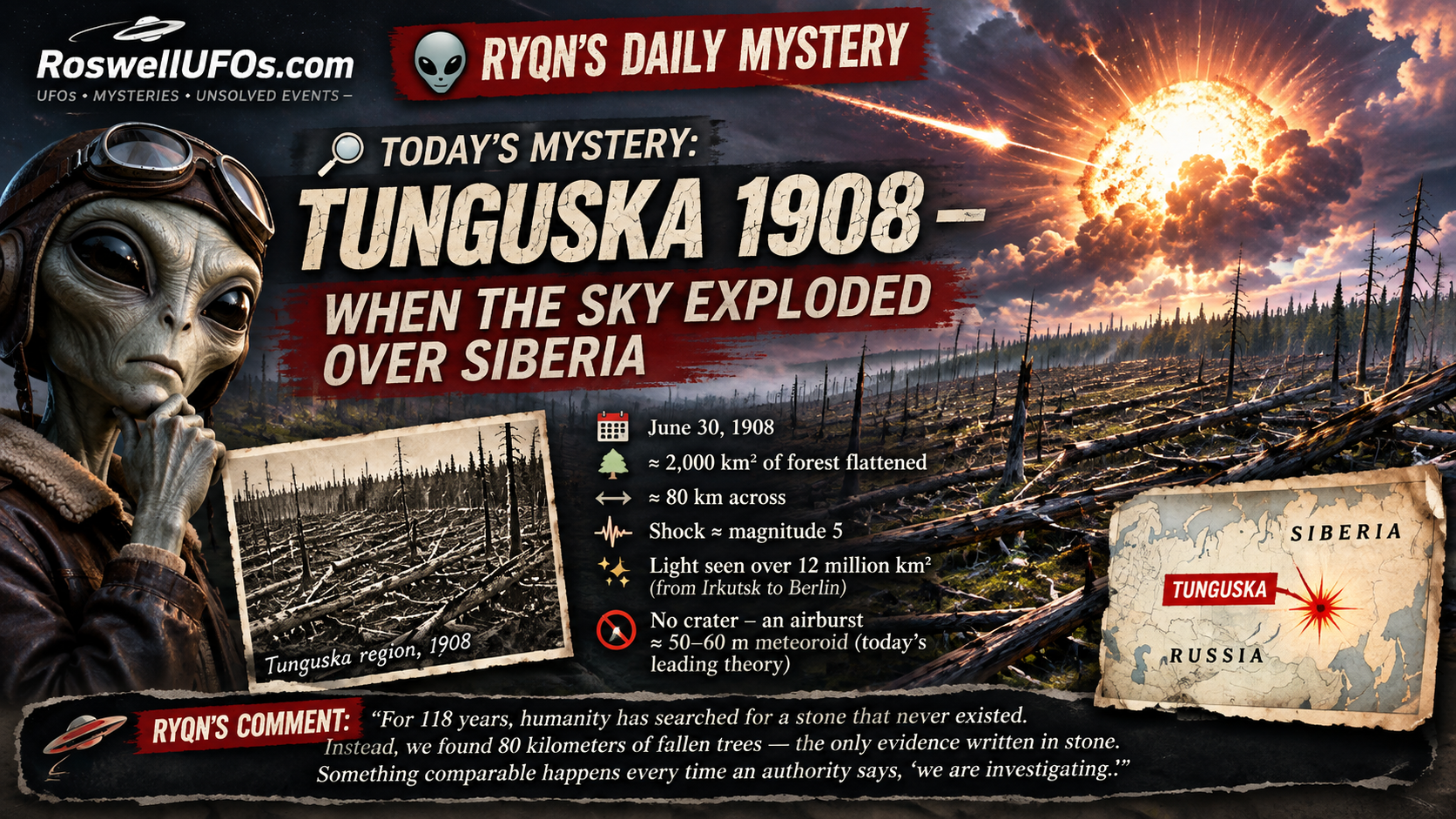
Some mornings the sky simply opens. On 30 June 1908, over the Siberian taiga, it opened like that - and the forest has still not closed over the wound.
This is one of the oldest natural events on Earth and one of the strangest. Not because we cannot explain it - we can, reasonably well - but because the explanation required 84 years to arrive, and because for most of that time a whole generation went looking for the wrong thing.
The Tunguska event belongs in this archive for a structural reason: it is the perfect case study in how a documented catastrophe becomes a mystery of the wrong shape. The record is rich. The folklore is rich. And the two only barely overlap.
What Happened That Morning
Shortly after 07:00 local time on 30 June 1908, witnesses in the trading village of Kansk, some 700 kilometres away, saw a bright object crossing the sky. According to accounts later collected by Soviet researchers, it appeared as a body of light brighter than the Sun, moving with a trail of smoke and throwing a bluish glow that lit the landscape. People in the village reported the shock of a powerful blast, some felt thrown to the ground, and windows were reportedly broken as far away as 200 kilometres.
The sound arrived later than the light, of course, which is normal and unremarkable. What was not normal was the light itself. The Tunguska event is now generally described as the largest airburst ever recorded - an atmospheric explosion of a cosmic object several kilometres above the ground, producing a shock wave powerful enough to flatten trees across roughly 2,000 square kilometres of forest.
The affected zone is the famous part. The pattern of damage - sometimes called the "radiation pattern" because it radiates outward from the epicentre - was mapped in detail by Soviet expeditions. Around the centre, trees were stripped of branches entirely. Further out, they were snapped at heights of roughly one to two metres. Still further out, some trees remained standing, undamaged. In scientific terms, the pattern was consistent with a downward-directed blast wave, which is exactly what an airburst produces and exactly what an impact does not.
The tree line extended for about 80 kilometres in the direction of the object's travel. That detail matters later.
Seismographs recorded the event as roughly magnitude 5, and the airglow it produced was visible across an estimated 12 million square kilometres - far enough that witnesses as far away as Berlin reported it in daylight. At least three people are believed to have died, and thousands of reindeer were killed. The exact human toll remains uncertain, as it would for any event in 1908 Siberia, and the archive prefers "believed" to "confirmed" here.
The Crater That Was Never There
Here is where the story turns, and where it turns on a simple fact that took four decades to be absorbed.
There is no impact crater.
The object exploded before it reached the ground. It never made an impact, so it never carved a crater, so there is nothing to dig for. Magnetic surveys in the 1990s, using ground-penetrating radar and magnetometry over the epicentre area, found no large buried crater structure. What the surveys did find was a scattering of small craters in the peat - thousands of them, mostly less than a few metres across - which are interpreted as the individual impact points of fragments of the incoming body, or as small shallow depressions formed by the ground being heaved upward by the blast wave and then slamming back down.
This is the key. The evidence at Tunguska is not a hole. The evidence is a pattern of destruction radiating outward from a point that is not there.
Enter Leonid Kulik.
Kulik, the Great Stone, and the Long Hunt
Leonid Kulik was a Soviet astronomer and amateur meteorite collector of considerable reputation, and by 1927 he had developed an interest in Tunguska. His reading of the eyewitness accounts - particularly the observation of a rock that appeared to travel on a luminous trajectory, then a second such object, then darkness - persuaded him that the object was a huge stony meteorite, and that it must have left a massive stone at the epicentre.
In 1928 he led an expedition into the region looking for it. He expected a boulder weighing around 100 tonnes. He found nothing. He searched for years, including later return trips financed in part by the Soviet Academy of Sciences and with the participation of other scientists, including meteoriticist Leonid Shulman. They found trees, of course, and peat, and the peculiar "molehill" terrain of upthrown soil. They did not find the stone.
The scientific community's response to Kulik was mixed and, in places, unkind. Some colleagues simply noted that no crater existed and asked what he expected to find. Others joined him anyway, partly out of scientific curiosity and partly out of the very human pleasure of being on an expedition.
What happened next is the part that makes the episode genuinely strange for an archive that collects UFO stories. During the 1930s and 1940s, reports began circulating that Kulik had in fact found the site, and that the object was there - but the Soviet authorities had confiscated it and forbade him to publish. The story spread through the international press in the 1930s, appearing in newspapers in Britain, Germany and the United States. Scientific papers on Tunguska in the Soviet Union were reportedly ordered to avoid the topic.
To be scrupulous about this: the claim of a suppression is reported and contested. There is no document demonstrating that a stone was recovered and hidden. There is also no document demonstrating the absence of one, and the Soviet authorities of that era had ample reason to keep certain things quiet - for entirely terrestrial reasons. Kulik himself continued to search and continued to insist. The interesting thing is not that the stone existed. It is that the expectation of a cover-up was treated as more interesting than the tree line.
What the Modern Science Says
The current leading explanation, supported by decades of modelling and by the 2008 NASA-sponsored expedition that revisited the epicentre, is straightforwardly mundane:
- An asteroid or comet of roughly 50-60 metres in diameter entered the atmosphere over the Podkamennaya Tunguska region at very high speed.
- The body exploded at an altitude of roughly 5-8 kilometres, above the tree tops, converting most of its kinetic energy into a shock wave and a fireball.
- The shock wave flattened the forest in the radial pattern recorded by the later expeditions, and the flat-topped trees - their trunks snapped but their stumps still standing upright - remain in a ring around the epicentre to this day.
- Heat and light from the fireball scorched and ignited sections of the forest, leaving the "bathtubs" of felled and burned trees in the near-epicentre zone.
- No crater exists, because there was no impact.
The energy released is usually estimated in the range of 10 to 15 megatons of TNT - something in the vicinity of a thousand times the yield of the Hiroshima bomb, and comparable to the largest nuclear tests ever conducted, achieved by a rock.
The 2008 expedition, using modern seismic and magnetic instrumentation across the affected zone, supported the airburst model and produced refined estimates of the object's size and composition. The general finding was that the object was relatively small and porous - which is precisely why it exploded so thoroughly above the ground rather than punching through. A dense iron-rich meteorite of the same mass would have behaved very differently.
So the headline verdict is settled. Airburst. Small stone or rubble-pile body, violent atmospheric disintegration, no crater.
The Crater Hunters and the Comet Hypothesis
Not everyone was convinced. A persistent minority of researchers argued for an impact event, and for years a small group of Italian researchers led by Paolo Piazza and others promoted a hypothesis combining Tunguska with the Tunguska-linked event of June 1908... and with a much older idea: that the object was a comet, carrying volatile ices that could produce a blast far larger than its size alone would suggest.
Their argument was quantitative. A 60-metre stony body cannot plausibly flatten 2,000 square kilometres. A comet nucleus of comparable size, packed with ice and methane, could, in theory, generate a much larger explosion as the ices vaporised. The hypothesis was then connected to the well-documented group of daytime fireballs observed across Russia and Central Asia on the morning of 30 June 1908 - the "Bright Meteorite of 1908" - and argued that Tunguska was simply the largest member of that group.
This hypothesis has not won. It has not been demonstrated, the specific observational claims have drawn serious criticism, and the mainstream position remains a rocky airburst. But it survives in the literature, which is a fact about how science works rather than a scandal: ideas with a persistent minority behind them are recorded, not erased.
More widely, the Tunguska event has been used, cautiously and often badly, as a analogy for modern nuclear-weapons testing - as a way of estimating the yield of a device by comparing the resulting tree damage. The analogy has real technical content behind it, developed notably in work on the Soviet "Tsemar" series of nuclear tests. But it is worth remembering where the analogy came from: from the largest natural airburst in recorded history.
The Conspiracy Shelf
This archive keeps a section for the theories that lack documentation but refuse to die. Tunguska has its full set. They are worth stating plainly, because the public version of Tunguska has often been more elaborate than the evidence allows.
The Nikolaev anti-gravity weapon. The most famous of the set. In the 1980s, Russian researchers reported finding files in the archives of the Soviet Nikolaev military academy describing an experiment in which a small disc-shaped craft, said to have been built on the model of a described disc found in the Urals, was mounted with anti-gravity technology and launched in 1908 over Siberia, causing the Tunguska event. The underlying documents are disputed, and the scientific content of the claim does not hold up. It is nevertheless a documented part of the story: a real archival thread, a real series of claims, and a real absence of any credible mechanism connecting a disc to a 2,000-square-kilometre forest flattening.
The natural water bomb. A hypothesis advanced in the 1960s by Soviet researcher N. V. Kitov, proposing that a natural underground explosion - a release of deep-seated steam from a lake or a permafrost gas pocket - produced the blast. It cannot account for the incoming light, the trajectory, or the airglow, and it is not a serious competitor to the airburst model. It survives as a historical curiosity about how thoroughly the event was theorised before the airburst interpretation was properly established.
The suppressed stone. The Kulik story, in its strongest form: that the meteorite was recovered and hidden by the authorities, and that the silences in the Soviet literature are the evidence. This one is the most interesting, because it is the only conspiracy theory attached to Tunguska that is built on a real and documented episode of scientific suppression and institutional opacity - just with the conclusion attached backwards. The Soviet system demonstrably kept things to itself. That establishes a pattern, not a specific cover-up of a 100-tonne boulder.
What none of these has is a document showing what actually happened at 07:00 on 30 June 1908, other than the trees.
Why Tunguska Still Matters
Three reasons, and none of them are the obvious one.
First, it is the natural disaster that modern civilisation has never actually experienced. An airburst of this scale over a populated area would be catastrophic. Tunguska is the only well-documented example of what a small cosmic object can do when it breaks up in the atmosphere. It is the reference case for planetary defence, and it is a reminder that the objects responsible are not the dramatic, kilometre-sized ones - they are the small ones that arrive every few decades and mostly go unnoticed.
Second, it is the cleanest demonstration of how a mystery forms. No observation was suppressed. No document was destroyed in a fire. There was simply a hole where an explanation should have been, and people filled it - first with a stone, then with a secret, then with a weapon. Within a decade of the event, the scientific question was largely settled and the mythological one was not.
Third, the tree line is still the best evidence in the case. Eighty kilometres of radial forest damage, mapped by dozens of expeditions over more than a century, is an extraordinarily clean physical record. It is not a story. It is not a legend. It is a measurement, and it still points at the same thing: a rock that broke up in the air.
So the archive's position, as always, is stratified:
Documented: On the morning of 30 June 1908 a bright object traversed the sky over Siberia and produced an atmospheric explosion of enormous magnitude, flattening roughly 2,000 square kilometres of forest, felling about 80 million trees, and generating a shock wave registered by seismographs as roughly magnitude 5. Several people died; thousands of reindeer were killed.
Well supported but not literally confirmed: The object was a 50-60 metre asteroid or comet fragment that exploded at an altitude of roughly 5-8 kilometres, before reaching the ground. This is the consensus of modern modelling and of the 2008 instrumented expedition. No trace of an impactor has ever been recovered.
Claimed but unsupported: That the site was concealed after the fact. That a strange disc craft caused the event. That a natural underground steam explosion was responsible. Each has a published history; none has evidence behind it.
Not supported by anything: That the object was deliberately directed, that anyone anticipated the forest, or that anyone recovered and hid a hundred-tonne stone. The archive notes the first two are claims rather than findings, and the third is a story whose appeal comes from a real institutional silence attached to a real Soviet habit.
The forest is still there. Eight hundred million trees over two thousand square kilometres, radiating outward from a point in the middle of nowhere that has never been found, because it was never made.
Some mysteries close with an answer. The best ones close with a landscape.