
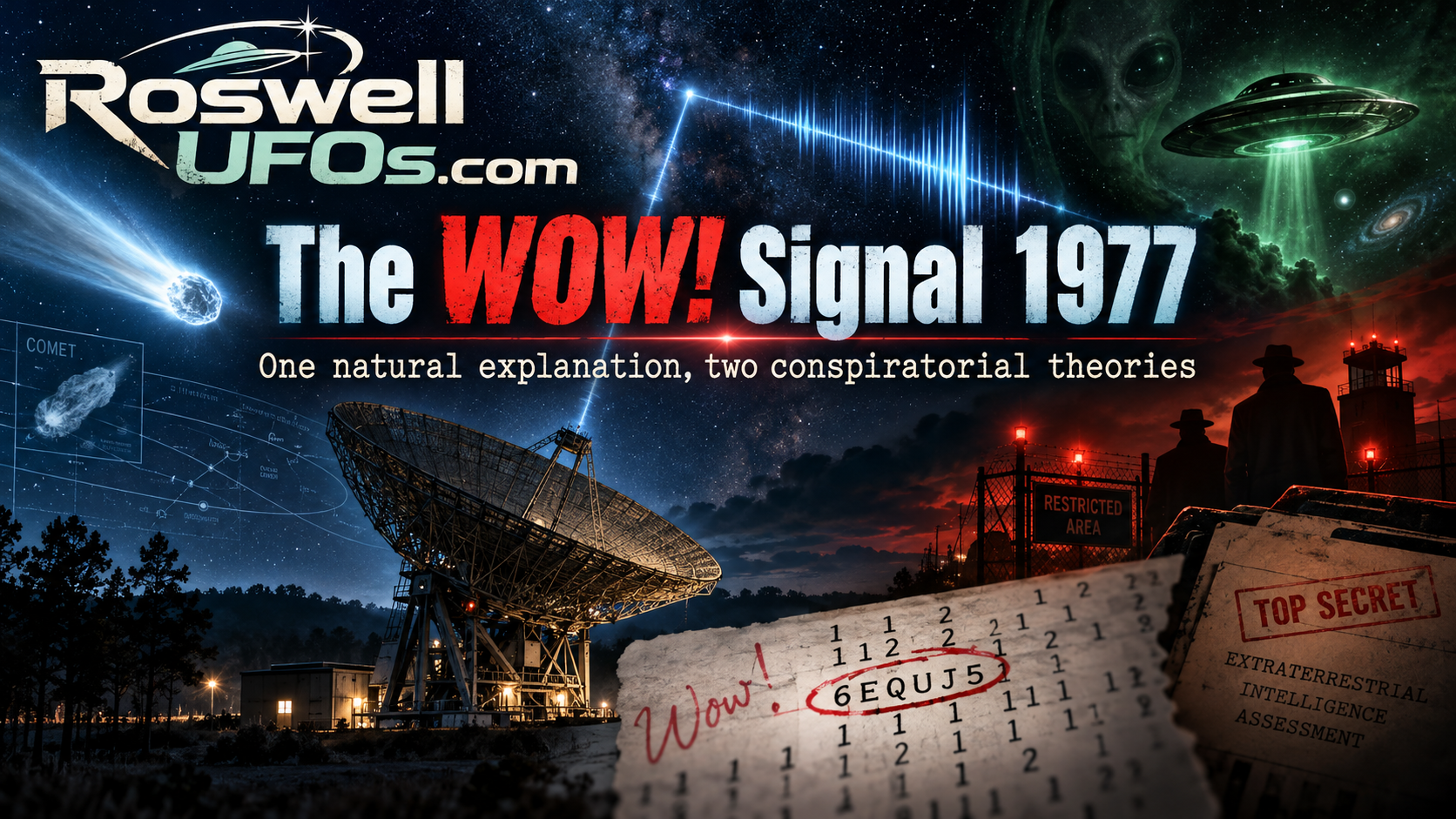
Somebody wrote "Wow!" on a printout in 1977, and almost fifty years later the universe still has not bothered to explain it.
The event is one of the few in this archive where the evidence is not in dispute. A radio telescope heard something. A volunteer named Jerry Ehman found it in the data, circled six characters on a fanfold printout, and wrote one word next to them. Everything that came afterwards - the books, the documentaries, the government inquiries, the cryptids, the classified folders - is interpretation stacked on top of that single moment.
So let us be orderly about it. First what is documented. Then the strongest natural explanation. Then the two conspiratorial theories that have kept this story warm for half a century.
What the Record Actually Shows
On the night of 15 August 1977, at 22:16 EST (23:16 EDT, 03:16 UTC on 16 August), the Big Ear radio telescope at the Ohio State University Radio Observatory near Delaware, Ohio was doing what it had been doing for years: pointed at a fixed spot in the sky and let the Earth's rotation sweep its beam across.
Because the mount could only be adjusted in altitude, any given point in the sky stayed inside the beam for exactly 72 seconds. That number becomes important later.
The telescope recorded fifty channels, each 10 kHz wide, on an IBM 1130 computer and a line printer. The output was not a spectrum but a table of alphanumeric characters, one per channel per sampling interval, each character encoding how far the signal in that channel sat above the background noise in units of standard deviation. Blank space meant zero to one. Digits 1 to 9 meant one to nine. Letters started at A for ten, B for eleven, and so on.
Ehman, a volunteer on the SETI project, was reading the printouts by hand days later. He found a line containing:
6EQUJ5
The "U" was the peak - thirty standard deviations above the noise baseline. He circled it and wrote "Wow!" in the margin. The original document is preserved by the Ohio History Connection in Columbus.
Three details make this strange:
- The signal sat at roughly 1420.4556 MHz (Ehman's 1998 figure), about 50 kHz above the neutral hydrogen line at 1420.4058 MHz - the 21-centimetre band, which is where physicists had already argued any serious alien broadcaster would start, because hydrogen is everywhere.
- Its intensity rose for about 36 seconds and then fell for about 36 seconds. That is not what a flashing signal looks like. That is what a steady source looks like passing through a beam - which is exactly what a genuine transmitter would do, and what an ordinary natural transient generally would not.
- It lasted the full 72 seconds. Not 70. Not 80. Every second the telescope could see it.
And then it never happened again. Not once. Not with a slightly different strength, not for a fraction of a second, not in the same part of the sky. Follow-up observations with the more sensitive Very Large Array in 1995 and 1996, and six 14-hour sessions with the 26-metre telescope at Mount Pleasant in Tasmania in 1999, found nothing resembling it. Ehman and his colleagues searched the same region repeatedly and got silence.
The most quoted assessment of the moment comes from Robert Dixon, who directed the observatory at the time: the signal followed the telescope's beam shape, which indicated it was at least as far away as the Moon, and it stopped when the telescope looked away, which pointed to an intelligent origin rather than a natural phenomenon. He added that efforts to re-observe it have failed, and that this will likely remain a perpetual mystery.
The Natural Explanation: A Comet With a Hydrogen Halo
The leading natural candidate came from an unexpected direction. In 2017, Antonio Paris of St. Petersburg College in Florida published a paper proposing that the signal was produced not by a transmitter but by the hydrogen cloud around a comet.
The reasoning is elegant. Neutral hydrogen emits strongly at 1420 MHz. A comet carries a huge cloud of hydrogen - the coma - and when the comet passes near the Sun, that hydrogen is stripped off and lit up. The argument was that two comets, 266P/Christensen and P/2008 Y2 (Gibbs), were in the same region of sky in August 1977, and that a comet's hydrogen emission, seen against the telescope's narrow beam, could produce a narrowband signal at exactly the hydrogen line with an intensity profile that rises and falls as the comet drifts across the field of view.
It is the kind of hypothesis that feels like a key turning in a lock. The signal was at the hydrogen frequency. A comet produces hydrogen emission at the hydrogen frequency. The geometry might even have supplied the 72-second taper.
It did not survive scrutiny. Robert Dixon and NAAPO published a detailed rebuttal arguing that the comets' actual positions and predicted brightness did not match the recorded signal, and that the hydrogen emission profile could not produce the observed amplitude curve. As with most SETI cases, the press coverage of the original claim was considerably larger than the coverage of its dismantling.
Two other natural families remain in play, neither of them confirmed:
- Interstellar scintillation. A faint, steady signal passing through turbulent interstellar plasma would brighten and dim like starlight twinkling. The problem is that the Very Large Array is far more sensitive than Big Ear, so a source faint enough to be flattered by scintillation should probably have been detected by the VLA - and it was not.
- A stochastic repeating beacon. In 2022, David Kipping proposed in a Monthly Notices paper that the signal could have come from a network of randomly triggered transmitters - one of them firing at just the right moment, from just the right direction, with just the right strength. It is mathematically elegant, and it explains why a repeat never came: the odds of a recurrence were astronomically low.
Ehman himself once favoured something more mundane. In 1994 he said the signal may have been an Earth-sourced transmission reflected off a piece of space debris - a reflection would explain the beam-shaped intensity profile without needing a transmitter at the source. He later walked that back after working out that a reflector of the required size and shape would be physically implausible.
So: the natural explanation is not a single solution but a family of candidates, each with a specific weakness. The comet theory has a geometry problem. The scintillation theory has a sensitivity problem. The debris theory has a physics problem. That is not the same as having an answer, but it is not the same as having nothing either.
Conspiracy One: It Was Military, Terrestrial, and Classified
This is the theory that the signal was never extraterrestrial at all - that it was our own technology, and that somebody with the appropriate clearance knows exactly what it was.
The case is assembled from circumstance rather than documents, and it is worth laying out plainly so that readers can weigh it themselves.
The frequency problem. 1420 MHz is part of the radio astronomy protected spectrum. Terrestrial transmitters are not supposed to operate there. If the Wow! signal was a leak, a stray carrier, or a deliberate transmission, then it broke a rule - which means a class of people who knew it broke a rule and said nothing. The silence is the conspiracy's best asset and its weakest evidence simultaneously.
The geography. The Big Ear telescope sits in Ohio, comfortably inside the range of several large over-the-horizon radar systems and of the transmitting infrastructure clustered around military test ranges. A narrowband pulse on a hydrogen-adjacent frequency is not an exotic thing to produce on this planet. It is the sort of thing that happens when a large transmitter sweeps.
The classification instinct. The archive's preferred reading is that if an alien transmission had been received in 1977, it would have been classified immediately and the story would have been dead rather than famous. The fact that the story is famous is sometimes presented as evidence that no alien was involved - that the only thing being protected was something domestic.
What makes it attractive. A terrestrial origin explains the single occurrence, the narrow bandwidth, the unmodulated character, the exact 72-second taper, and the total absence of any repeat. Every one of those is awkward for the comet and scintillation hypotheses and easy for the military hypothesis. It also explains why nobody has ever reproduced it: military transmissions are not on a schedule.
What it lacks. No document released under any Freedom of Information Act has shown an official investigation of the Wow! signal as a security matter. No witness has come forward with a first-hand account of a classified transmission matching the description. No government has ever admitted or denied it. What the theory has is a plausibility of circumstance - and plausibility, while satisfying, is not the same as evidence.
Conspiracy Two: The Signal Was Never a Signal
The second theory is more radical and less popular, but it has a sharper point: that the legend of the Wow! signal is an artifact of documentation and retelling, and that the moment itself was considerably more mundane than the printout suggests.
It begins with a documented fact that is rarely mentioned. The Big Ear receiver's first local oscillator was specified at 1450.4056 MHz. The university's purchasing department made a typographical error on the order form, and the observatory received an oscillator running at 1450.5056 MHz - 100 kHz off. The software was written to compensate for the error, and Ehman took it into account when he calculated the Wow! signal's frequency. But consider what this means for the signal's coordinate identity: the central number in the most famous SETI detection was, in the end, the output of a manual correction to an earlier manual error.
From there, the argument proceeds.
The characters are not a message. "6EQUJ5" is not code, not a greeting, not an address. It is six successive intensity readings on a scale where one character equals one 10-second sample in one 10 kHz channel, and where the letters simply run past nine. Anyone who has ever described the signal as "reading something" has misread a ruler as a sentence. The most famous SETI artefact in history is a plotter chart, and the plotter chart has been reinterpreted as a message for fifty years.
The printout itself is a copy. The document in Columbus is the original; nearly every image of the famous circled characters is a later reproduction, cleaned up, cropped, recoloured, and re-typed. Some versions of the image even include the "Wow!" annotation in a different handwriting from later copies. The evidence has been through too many generations of copying to support any claim about what was on the page - including, potentially, claims about what was not.
The dramatic payoff. The claim runs that the signal was a measurement anomaly - a glitch, a carry-over, a channel that momentarily misbehaved in a machine that was, by modern standards, a marvel of complexity with 32 kilobytes of core memory and a printer that could take three seconds to think. And that the institutional incentives then and now have always favoured the spectacular reading. A SETI program competing for attention and funding benefits enormously from a 72-second contact. The story has been told, retold and monetised for half a century by people who had no particular stake in it being complicated.
The hardest problem for this theory. A glitch should not produce a clean, symmetric, beam-shaped taper that rises for 36 seconds and falls for 36. Instrument errors are usually lumpy, one-sided, or sudden. Whatever the Wow! signal was, it was not random.
Where the Archive Lands
RoswellUFOs.com covers public records, reported claims and popular history for entertainment and research. So here is the position this archive is willing to defend:
Documented: A narrowband signal was recorded at the Big Ear telescope on 15 August 1977, peaked thirty standard deviations above baseline in a single channel, held for the full 72-second observation window with a beam-shaped intensity profile, and was never seen again by any instrument since.
Plausible but unconfirmed: A comet hydrogen cloud, a scintillating faint continuous source, or a stochastic beacon network. Each is a serious paper by serious people. Each has a documented problem.
Claimed but unsupported: That it was a military transmission. That it was an instrument artefact manufactured into a legend. Both are coherent, both have explanatory appeal, and neither has a document behind it.
Not supported by anything: That it was a greeting. The signal was unmodulated to within the limits of the equipment, and a continuous tone carries no message in any language - ours or theirs.
What the Wow! signal really demonstrates is not that we were contacted. It is that a single unrepeatable observation can survive for fifty years without anyone being able to close it - and that the gap between "we cannot explain this" and "we know what this was" is enormous, and filled with excellent writing.
The observatory that heard it no longer exists. The printout is in a museum. The search continues, because that is what the machines were built for - and because somewhere in the arithmetic, the universe owes us a second look.
Next time a meeting feels like a lost cause: look up.